The Eva team
Your AI general manager
Is a cleaning business profitable? Short answer: yes, and it is one of the easier businesses to start with very little money. But the honest answer has a catch. Cleaning is profitable when you price it right and keep your costs and your time under control. It quietly stops being profitable when you compete on price, undercharge, and end up working sixty hours a week for what feels like minimum wage. This guide gives you the real numbers, what actually drives the profit, and how to make sure your cleaning business pays you like a business and not a second job.
A note on where these numbers come from: employee wages are the floor of the math, and the Bureau of Labor Statistics puts the median pay for maids and housekeeping cleaners at roughly $16 per hour, while owners charge clients $25 to $80 per cleaner hour. That spread is the business. And the market is anything but empty: our own analysis of 25,000+ US cleaning businesses found an average Google rating of 4.8 stars, which means profitability comes from running tighter, not from being the only good option in town.
The short answer: yes, but the margin is thinner than people think
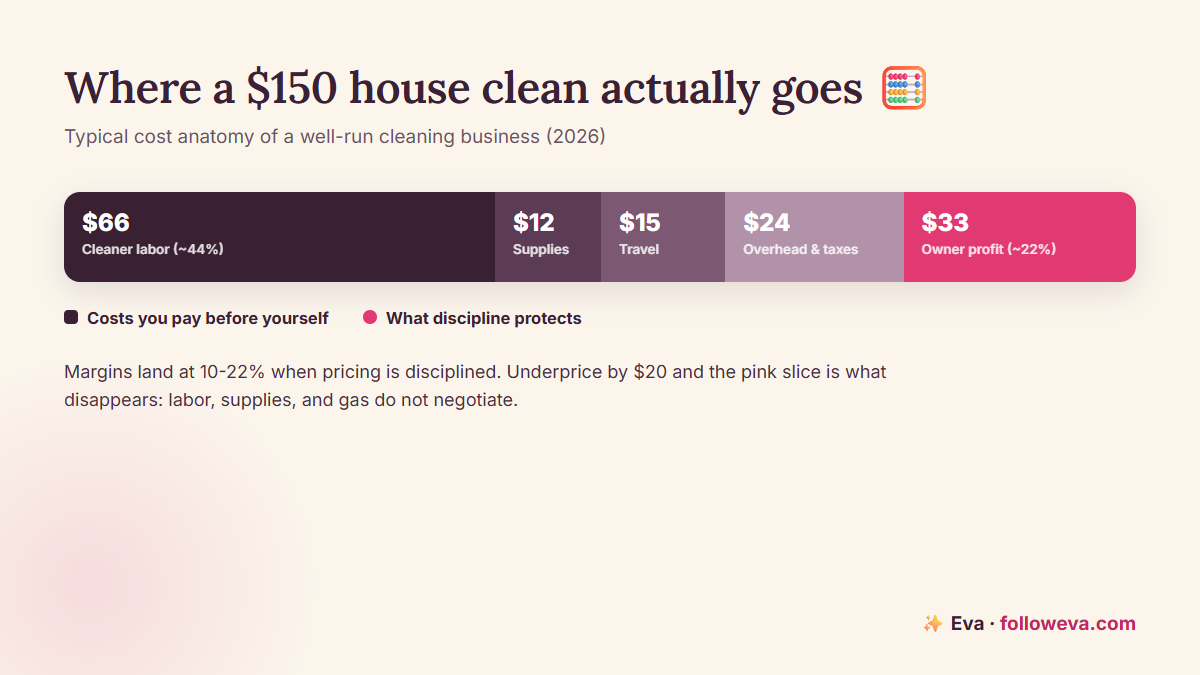
Residential cleaning is a real, durable business with steady demand: homes get dirty every week, in every economy. Net profit margins in residential cleaning typically land between 10 and 30 percent. A tight solo operation can run higher because your own labor is the main cost. Once you hire a team, margins usually settle between 10 and 20 percent, because labor is expensive and it is the biggest line on your books.
So the business is profitable, but not effortlessly rich. The owners who do well are not the ones with the most clients. They are the ones who price with intent, keep clients for years, and do not let admin and rework eat their margin. Profit in cleaning is a discipline, not an accident.
| Stage | Typical annual revenue | Typical net margin | The catch |
|---|---|---|---|
| Solo cleaner | $50,000 - $90,000 | Highest: your labor is the cost | If you stop, the income stops |
| Small team (3-6 cleaners) | $200,000 - $500,000 | 10-20% once payroll lands | Systems decide whether growth pays |
| Established (10+ cleaners) | $1M+ | 10-20%, run well | Sloppy margins can mean less take-home than a tight small team |
How much does a cleaning business actually make?
It depends entirely on your stage, but here are realistic ranges for US residential cleaning in 2026. A solo cleaner working full time often brings in 50,000 to 90,000 dollars a year in revenue, and keeps a large share of it because there is no payroll. The trade-off is that you are the business: if you stop, the income stops.
A small team of three to six cleaners commonly runs 200,000 to 500,000 dollars a year in revenue, with the owner taking home a salary plus profit on top once the systems are working. Established companies with ten or more cleaners cross into seven figures of revenue, but the owner's take depends heavily on how well the operation is run. More revenue with sloppy margins can mean less money in your pocket, which is the trap nobody warns you about. For a starting point on what to charge per job, run a few scenarios through our free house cleaning price calculator.
What makes a cleaning business profitable
A handful of levers decide whether your cleaning business prints profit or just keeps you busy. Get these right and the margin takes care of itself.
Pricing is the first and biggest lever. Charging even ten percent more on every job flows almost straight to profit, because your costs barely move. Most owners undercharge out of fear, which is the single most common reason a cleaning business stays broke. Our guide on how much to charge for house cleaning walks through the real numbers, and how to price cleaning jobs shows you how to build a price that protects your margin.
Recurring clients are the second lever. A home cleaned every two weeks is predictable revenue, a planned route, and almost no cost to acquire after the first visit. A business built on recurring clients is far more profitable, and far less stressful, than one chasing one-time deep cleans all month. Client retention is cheaper than client acquisition, every single time.
Efficiency is the third. Tight routes, the right crew size per job, and low rework (no going back because something was missed) protect the margin you priced in. Wasted drive time and redo visits are pure profit leaks.
Why some cleaning businesses are not profitable
Plenty of cleaning businesses stay busy and broke at the same time. The reasons are almost always the same, and they are all fixable.
The biggest one is competing on price. There is always someone willing to clean cheaper, and the client you win on price is the first to leave when a cheaper option shows up. The second is pricing on wages alone and forgetting taxes, supplies, travel, insurance, and a real profit margin, so the job looks profitable but is not. The third is high turnover and no-shows, where cancellations and last-minute gaps leave paid time unfilled.
The quiet killer, though, is the owner's own time. When everything (the quoting, the scheduling, the reminders, the invoicing, the chasing of late payments) runs through you, your growth caps at how many hours you can personally work. You are profitable on paper and exhausted in real life. That is not a pricing problem, it is an operations problem.
How to make your cleaning business more profitable
If your business is busy but the bank account does not show it, here is where the profit usually hides, in order of impact.
Raise your prices, deliberately and on a schedule. Most owners are underpriced and overdue for an increase. A small, well-communicated annual bump keeps you ahead of rising costs. Then shift your mix toward recurring clients, because predictable revenue is worth more than a slightly bigger one-time ticket. Next, plug the leaks: reduce no-shows and last-minute cancellations, tighten your routes, and stop absorbing scope creep when a client quietly adds rooms or tasks for the same price.
Finally, take the admin off your own plate. The hours you spend every evening on texts, scheduling, and invoicing are hours you are not paid for, and they cap how big you can grow. This is exactly the work an AI general manager like Eva is built to handle: she quotes new leads, confirms bookings, fills the schedule, and invoices and follows up on payment automatically. Handing off the back office is often what turns a profitable-but-exhausting business into one that actually pays you and gives you your time back.
How much does it cost to start, and when do you break even?
One reason cleaning is so attractive is the low cost to start. You can begin with a few hundred to a couple thousand dollars: basic supplies and equipment, liability insurance, a simple way to take bookings and payments, and licensing or registration for your area. You do not need an office, a warehouse, or a fleet.
Because the startup cost is low and demand is immediate, many solo cleaners are cash-flow positive within their first month or two, as soon as they have a handful of recurring clients. The harder leap is not breaking even, it is growing past yourself: that is where pricing discipline and good systems decide whether your second year pays better than your first. If you are still planning the launch, start with our step-by-step guide on how to start a cleaning business.
So, should you start one?
If you want a business with low startup cost, steady demand, and a clear path to a real income, residential cleaning is one of the most reliable options out there. Is a cleaning business profitable? Yes, as long as you treat pricing as a decision and not a guess, build on recurring clients, and refuse to let admin and rework quietly drain the margin you worked to earn.
The owners who thrive are not working harder than everyone else. They are charging what the work is worth, keeping their clients for years, and letting systems handle the busywork so their time goes to growth. Do that, and a cleaning business is not just profitable, it is one of the best small businesses you can build.
Cleaning business profitability: FAQ
What is the profit margin on a cleaning business?
Residential cleaning nets 10 to 30 percent. Solo operators sit at the high end because their own labor is the main cost; teams usually settle at 10 to 20 percent once payroll lands. Check where you stand with our free profit margin calculator.
How much do cleaning business owners make?
A full-time solo cleaner typically brings in $50,000 to $90,000 a year and keeps most of it. Owners of small teams commonly pay themselves a salary plus profit on $200,000 to $500,000 in revenue, if pricing and retention are disciplined.
Is cleaning a good business to start in 2026?
Yes, for the same reasons as always: low startup cost (often under $2,000), immediate demand in every economy, and recurring revenue once you win repeat clients. The risk is not the market, it is undercharging and drowning in admin.
Why is my cleaning business not making money?
Almost always one of four leaks: prices set by fear instead of math, too few recurring clients, no-shows and rework eating paid time, or every text and invoice running through you personally. Each is fixable, and pricing is the fastest lever.