The Eva team
Your AI general manager
Pricing is the single decision that decides whether your cleaning business survives its first two years. Charge too little and you work yourself to exhaustion while barely covering payroll. Charge too much without knowing why, and you lose bids you should have won. This guide gives you the real numbers US cleaners charge in 2026, the four pricing models you can choose from, and a step by step way to figure out how much to charge for house cleaning without guessing.
Two data points to anchor everything that follows. First, labor: the Bureau of Labor Statistics reports median pay for maids and housekeeping cleaners around $16 per hour, so any client rate below the mid-$20s leaves nothing for supplies, travel, taxes, or you. Second, competition: in our dataset of 25,000+ US cleaning businesses, 87% of rated companies hold 4.5 stars or more, so underpricing does not even buy you an edge; everyone already looks great on paper.
The short answer: typical house cleaning rates in 2026
Across most US markets, here is where rates land in 2026 for an average three-bedroom, two-bathroom home:
- Standard recurring visit: 120 to 250 dollars
- Hourly, per cleaner: roughly 30 to 50 dollars in most metros, 50 to 90 in high-cost cities like New York, San Francisco, Boston, and Seattle
- Per square foot: 0.08 to 0.20 dollars for standard cleans
- One-time deep clean: 1.5 to 2.5 times a standard visit, for the extra labor and detail
By home size and type of clean, typical 2026 ranges look like this:
| Home size | Standard clean | Deep clean | Move-out clean |
|---|---|---|---|
| 1 bed / 1 bath | $80 - $140 | $150 - $250 | $180 - $300 |
| 2 bed / 1-2 bath | $100 - $180 | $180 - $320 | $220 - $380 |
| 3 bed / 2 bath | $120 - $250 | $220 - $450 | $280 - $550 |
| 4 bed / 3 bath | $180 - $350 | $320 - $600 | $400 - $700 |
Treat these as anchors, not rules. Your real price depends on your local labor market, your overhead, the condition of the home, and the margin you need to actually grow. The ranges tell you when you are wildly off. They do not tell you what to charge a specific client. That is what the rest of this guide is for. For the full national breakdown by home size, frequency, and region, see our 2026 house cleaning prices report, and for a quick starting estimate, try our free house cleaning price calculator.
The four pricing models, and when each one works
There is no single correct way to price a clean. There are four common models, and most successful operators use a blend. Knowing the trade offs lets you pick the right one for each job instead of defaulting to whatever you used last time.
1. Hourly
Charges per hour, per cleaner. The simplest model and the safest when you do not yet know how long a job takes. The downside: it punishes you for getting faster, the better your team gets the less you earn for the same work, and clients get nervous because the final bill is unknown until you finish. Best for first-time cleans, hoarding or post-construction jobs, and any job where the scope is genuinely unpredictable.
2. Flat rate per visit
One fixed price for the whole clean. Clients love it because they know the cost up front, and you love it because efficiency becomes profit. The risk is underestimating a job and eating the loss. It pairs naturally with simple, professional invoicing. Best for established cleaners with enough completed jobs to estimate hours accurately; it rewards good systems and makes recurring revenue predictable.
3. Per square foot
Multiplies the home's square footage by a rate. It scales cleanly and is easy to explain, which makes it useful for quoting larger homes sight unseen. The weakness is that square footage ignores how dirty or cluttered a home is: a 2,000 square foot home with three kids, two dogs, and a year of deferred cleaning is not the same job as a tidy 2,000 square foot condo. Best for a starting estimate that you then adjust for condition.
4. Room-based or tiered packages
Price by number of bedrooms and bathrooms, or sell named packages such as Standard, Deep, and Move Out. This is the easiest model for clients to self-select from an online booking page, and the cleanest to automate. The trade-off is less precision than a flat rate built from a real walkthrough. Best for online booking and businesses that want a repeatable, productized offer rather than custom quotes every time.
How to build your price from the ground up
Whatever model you show the client, the price underneath has to cover four things. Skip any one and you are slowly going out of business while feeling busy:
- Labor, including payroll taxes and workers comp
- Overhead, supplies, equipment, insurance, fuel, software
- Taxes
- Profit, set deliberately, not as an afterthought
Here is the build.
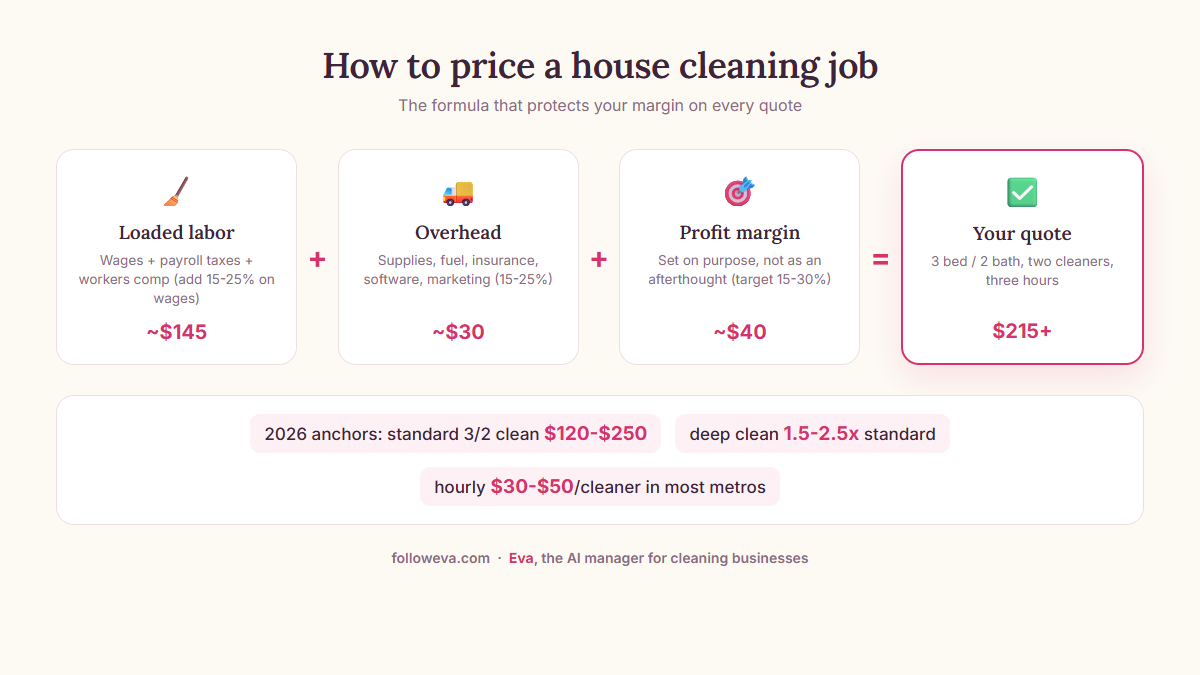
Start with labor. If you pay a cleaner 20 dollars an hour and a job takes two cleaners three hours, that is six labor hours, or 120 dollars in direct wages. Add payroll taxes and workers comp, which realistically add 15 to 25 percent on top of wages. So your true labor cost is closer to 140 to 150 dollars, not 120.
Next, add overhead. Supplies, equipment, insurance, fuel, software, phone, and marketing are real costs even though no single job seems to carry them. A common rule is to load 15 to 25 percent of the price for overhead. Then add your profit margin on top, not as an afterthought. Healthy residential cleaning businesses target 15 to 30 percent net profit. If you only mark up enough to break even, you have built yourself a demanding job, not a business.
Put together: 145 dollars in loaded labor, plus 20 percent overhead, plus a 20 percent profit target lands that example job somewhere around 215 to 230 dollars. Now compare that to your local market anchors. If competitors charge 180 for the same home, you either need to be faster, charge a premium you can justify, or accept a thinner margin on that segment. The math tells you where you stand before you ever send the quote.
The factors that should move your price up or down
Two homes of the same size can be very different jobs. Adjust your base estimate for the things that actually change labor time. Condition is the biggest one: a home that has not been cleaned in months can take twice as long as a maintained one. Clutter matters because cleaning around belongings is slower than cleaning open surfaces. Pets add hair, dander, and time. So do children's spaces.
Other real multipliers that should move the number:
- Number of bathrooms, the most labor-intensive rooms
- Kitchen condition
- Pet hair on upholstery
- High or vaulted ceilings
- Interior windows
- Add-ons such as inside the oven, inside the fridge, or interior cabinets
Build a short list of named add-ons with fixed prices. It makes upsells easy and stops you from absorbing extra work for free.
Recurring versus one time pricing
Recurring clients are the backbone of a stable cleaning business, so price to reward frequency. A home cleaned weekly stays easier to clean, which means less time per visit, which justifies a lower per visit rate than a one time clean. A typical structure: the first deep clean is your highest price, then weekly visits are discounted most, biweekly less, and monthly least, because a monthly home gets dirtier between visits and takes longer.
Frame the discount as a benefit of commitment, not a race to the bottom. For example: a one time clean at 250 dollars, weekly recurring at 150, biweekly at 175, monthly at 200. The client sees a clear reward for booking regularly, and you lock in predictable revenue and a route you can plan around. Predictable revenue is worth more than a slightly higher one off ticket.
How to quote a new client in minutes
You do not need a long in person walkthrough for most standard homes. A short intake gets you most of the way: square footage, number of bedrooms and bathrooms, pets, last time it was professionally cleaned, and any specific concerns. Run that through your model, apply your condition adjustment, and you have a quote. For large, neglected, or post construction homes, a quick walkthrough or a few client photos is still worth it to avoid a painful underestimate.
Speed of response matters as much as the number. The cleaner who replies with a clear, confident quote within the hour wins jobs over the one who takes two days, even at a higher price. This is exactly the kind of repetitive, time sensitive work that an AI general manager like Eva is built to handle: capturing the intake, pricing the job against your rules, and sending a professional quote while you are on a ladder somewhere. The fast, consistent response is often what closes the client.
Common pricing mistakes that quietly kill margins
The big three that quietly drain your margin:
- Pricing on wages alone and forgetting taxes, overhead, and profit.
- Competing on being cheapest, which attracts price shoppers who leave the moment someone undercuts you.
- Never raising prices: your costs rise every year, so flat pricing is a slow pay cut. Plan a modest annual increase and tell clients in advance with a short, warm note. Our Academy lesson on raising your cleaning prices gives you the script.
Other quiet margin killers add up just as fast:
- Absorbing scope creep when a client adds rooms or tasks without a price change
- Quoting too slowly and losing the job
- Pricing every home the same regardless of condition
Each one feels minor in the moment. Together they are the difference between a business that pays you well and one that runs you ragged.
Putting it all together
Start from your local market anchors so you know the playing field. Build your real price from loaded labor, overhead, taxes, and a deliberate profit margin. Pick the pricing model that fits the job, adjust for the home's actual condition, and reward recurring clients with structured frequency discounts. Then respond fast and consistently, because the quote that arrives first and reads with confidence usually wins.
Price is not a number you set once. It is a system you run on every job. Get the system right and your pricing stops being a source of anxiety and starts being the lever that grows your business.
House cleaning pricing: FAQ
How much should I charge to clean a 3 bed, 2 bath house?
In most US markets in 2026, $120 to $250 for a standard recurring clean, $220 to $450 for a deep clean, and $280 to $550 for a move-out. Adjust up for condition, pets, and high-cost metros, and run your specifics through our free price calculator.
How much should I charge per hour for house cleaning?
Roughly $30 to $50 per cleaner per hour in most metros, and $50 to $90 in high-cost cities like New York, San Francisco, Boston, and Seattle. Remember that hourly punishes efficiency: most established owners move to flat-rate once they know how long their jobs take.
How do I estimate a house cleaning job?
Collect a short intake (square footage, bedrooms, bathrooms, pets, last professional clean), build the price from loaded labor plus overhead plus a deliberate margin, then adjust for condition. Send the quote fast: the confident number that arrives first usually wins the job.
How much more should a deep clean cost than a standard clean?
Typically 1.5 to 2.5 times your standard visit price, because baseboards, appliances, and buildup add real labor hours. Price it as a named package so clients self-select instead of negotiating scope line by line.