The Eva team
Your AI general manager
A cleaning business plan does not need to be a fifty-page document that sits in a drawer. For most owners, it is a short, honest answer to a few questions: what you offer, who you serve, what you charge, how you will get clients, and how the work gets done. Writing it down forces the decisions that otherwise stay fuzzy and cost you money later. This guide gives you a lean cleaning business plan you can finish in an afternoon and actually use, and it is the single most useful hour you will spend before you take on clients.
Do you really need a business plan to clean houses?
If you are not raising money or applying for a loan, you do not need a formal plan. But you do need the thinking behind one. A one-page plan keeps you from the two most common mistakes: charging too little because you never did the math, and chasing every type of client because you never decided who you serve. Write it for yourself, not for a bank. If you are at the very start, pair this with our step-by-step guide on how to start a cleaning business.
What to put in a cleaning business plan
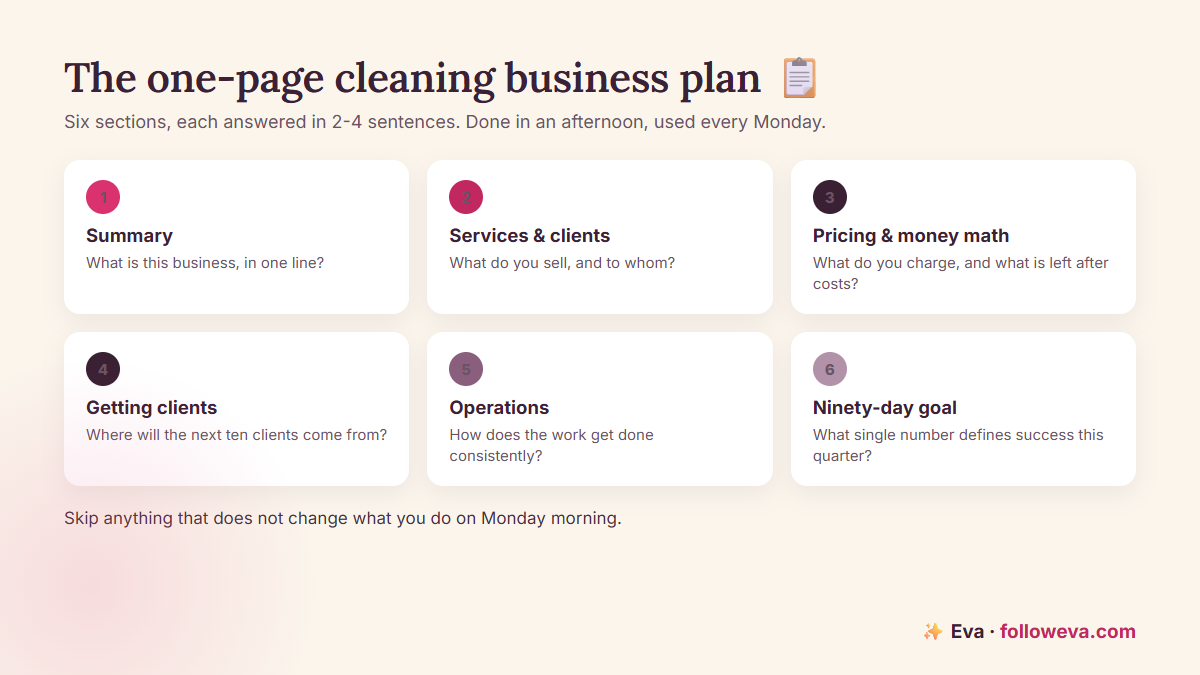
Keep it to the parts that change what you do on Monday morning. A useful cleaning business plan covers six things: a one-line summary of the business, the services you offer and who they are for, your pricing and basic money math, how you will get clients, how the work gets done day to day, and a simple goal for the next ninety days. That is it. Everything else is detail you can add once you are running, so do not let a blank template stop you from starting.
The free one-page cleaning business plan template
| Section | The question it answers | Example |
|---|---|---|
| 1. Summary | What is this business, in one line? | Recurring home cleaning for busy families in North Austin |
| 2. Services & clients | What do you sell, and to whom? | Weekly and biweekly cleans; add-on deep cleans for existing clients |
| 3. Pricing & money math | What do you charge, and what is left after costs? | $140 average clean, ~55% margin after labor, supplies, travel |
| 4. Getting clients | Where will the next ten clients come from? | Referrals + local Facebook groups + a booking page with reviews |
| 5. Operations | How does the work get done consistently? | Shared checklist per home, reminders and invoicing automated |
| 6. Ninety-day goal | What single number defines success this quarter? | 12 recurring clients, or $2,500/week in revenue |
Your services and who they are for
Decide what you sell and to whom before you decide anything else. Most new cleaning businesses do best by starting narrow: recurring residential cleaning in a specific area, for example, rather than residential plus commercial plus move-outs all at once. Naming your ideal client (busy families, busy professionals, landlords turning over units) shapes your pricing, your marketing, and even how you answer the phone. You can always add services later once the first one is reliable and profitable.
Pricing and the money math
This is where most plans get vague and most businesses leave money on the table. Decide your prices on purpose, and check that they leave you a real profit after paying for labor, supplies, and travel. Use our free house cleaning price calculator to anchor a fair price by home size and clean type, and read how much to charge for house cleaning for the full breakdown. To pressure-test the money side, our cleaning business startup costs and profit report lays out typical startup budgets and the margins a well-run cleaning business actually keeps. Then sanity-check the other direction: at that price, how many cleans a week do you need to hit the income you want? Resist competing on price alone, because there is always someone cheaper, and the clients you win on price are the first to leave when someone undercuts you.
How you will get clients
A plan without a way to get clients is a hobby. Pick two or three channels you will actually use: referrals and word of mouth, local Facebook groups, a simple booking page, and asking every happy client for a review. You do not need a marketing budget to start; you need a clear offer and a way for people to say yes without a phone call. Our guide on how to get cleaning clients covers the practical playbook, and a clean online booking page removes the friction that loses you new clients. Track where each new client came from for the first few months, so you double down on what works instead of guessing.
Operations: how the work actually gets done
The part new owners skip is how the business runs once the phone starts ringing: how you schedule jobs, how you keep quality consistent, how you invoice and get paid. Write down your standard so it survives your first hire. A shared cleaning checklist is the simplest quality system, and you can build one free with our cleaning checklist generator. Decide how you will handle scheduling, reminders, and getting paid on time before the volume forces the decision for you.
Set one ninety-day goal
Finish the plan with a single, concrete goal for the next ninety days: a number of recurring clients, a weekly revenue figure, or your first hire. One goal you can measure beats five vague intentions. Revisit it monthly and adjust as you learn what your market actually pays for. A plan is only useful if it stays a living document rather than a one-time exercise you never open again.
Run the plan without the busywork
The plan sets the direction; the daily running is what wears owners down. That is where Eva comes in: she quotes new leads, books and schedules jobs, sends invoices, chases late payments, and keeps your cleaners on track, so the operations section of your plan runs itself. It is the difference between writing a plan and actually having the system to execute it. Start free and put your plan into motion from day one.
Cleaning business plan FAQ
Do I need a business plan to start a cleaning business?
Not a formal one, unless you are applying for a loan or funding. You do need the thinking behind one: who you serve, what you charge, and how you get clients. The one-page outline above covers exactly that in an afternoon.
What should a cleaning business plan include?
Six sections: a one-line summary, your services and ideal clients, pricing and the money math, how you will get clients, how the work gets done day to day, and one measurable ninety-day goal. Skip anything that does not change what you do on Monday.
Is there a free cleaning business plan template?
Yes, two ways: copy the six-row table in this guide, or use our free business plan generator, which turns the same six questions into a printable one-page plan. Ground the pricing section with the price calculator so the numbers are real.
How do I write the financial part of a cleaning business plan?
Start from one clean: price, minus labor, supplies, and travel, equals your margin per visit. Multiply by realistic weekly volume to see your income. Our startup costs and profit report gives typical budgets and the margins well-run cleaning businesses keep.