The Eva team
Your AI general manager
Hiring your first cleaner is the moment a cleaning business stops being a job and starts being a business. It is also where many owners get burned: a bad hire costs you clients, redone work, and your weekend. This guide covers how to hire cleaners for your cleaning business the practical way, from knowing when you are ready, to where to find good people, what to pay, how to screen them, and how to keep the quality consistent once they are on your team.
When you are ready to hire your first cleaner
The signal to hire is simple: you are turning down work, or you are working past the point where your quality or your sanity holds. If you are booked solid and saying no to good clients, a hire pays for itself. If you are still filling your week, focus on getting clients first. A good rule is to hire when you have at least two to three weeks of consistent overflow that one extra person could cover. If your real bottleneck is the admin rather than the cleaning, you may need a different kind of help: see when to hire a manager for your cleaning business.
Employee or independent contractor?
This is the first real decision, and getting it wrong is expensive. An employee (W2) can be trained, scheduled, and held to your standard and your checklist; you handle payroll taxes and you control how the work is done. An independent contractor (1099) works on their own terms, which gives you less control and creates legal risk if you treat them like an employee. The rules vary by state and misclassification penalties are real, so check your state's worker-classification guidance before you decide. Most cleaning businesses that care about consistent quality end up hiring employees, because you cannot enforce a checklist or a schedule on a true contractor. Our Academy lesson on employee, subcontractor, or self-employed cleaners walks through the decision in detail.
Where to find good cleaners
Good cleaners come from a few reliable places. Referrals from your current cleaners and clients are the strongest, because they arrive pre-vetted and tend to stay. Local Facebook groups and community pages work well and cost nothing. Job boards like Indeed bring volume, so you screen more but reach more people. Do not overlook your own clients and neighbors; someone reliable who already knows your standard is gold. Post in more than one place at once, because good cleaners get hired fast and the first business to respond often wins.
Write a job post that attracts the right people
A vague post ("hiring cleaners, apply now") attracts everyone, including the wrong people. A specific post attracts the person who wants exactly that job and quietly screens out the rest, which saves you a pile of interviews. Name the pay and the schedule up front, be honest about the physical work, and spell out what a great clean looks like. List the responsibilities, the requirements, and what you offer, such as weekly pay, paid drive time, and supplies provided. You can build a clear, professional post in a minute with our free cleaner job description generator, then paste it straight into Indeed or Facebook.
How much to pay cleaners
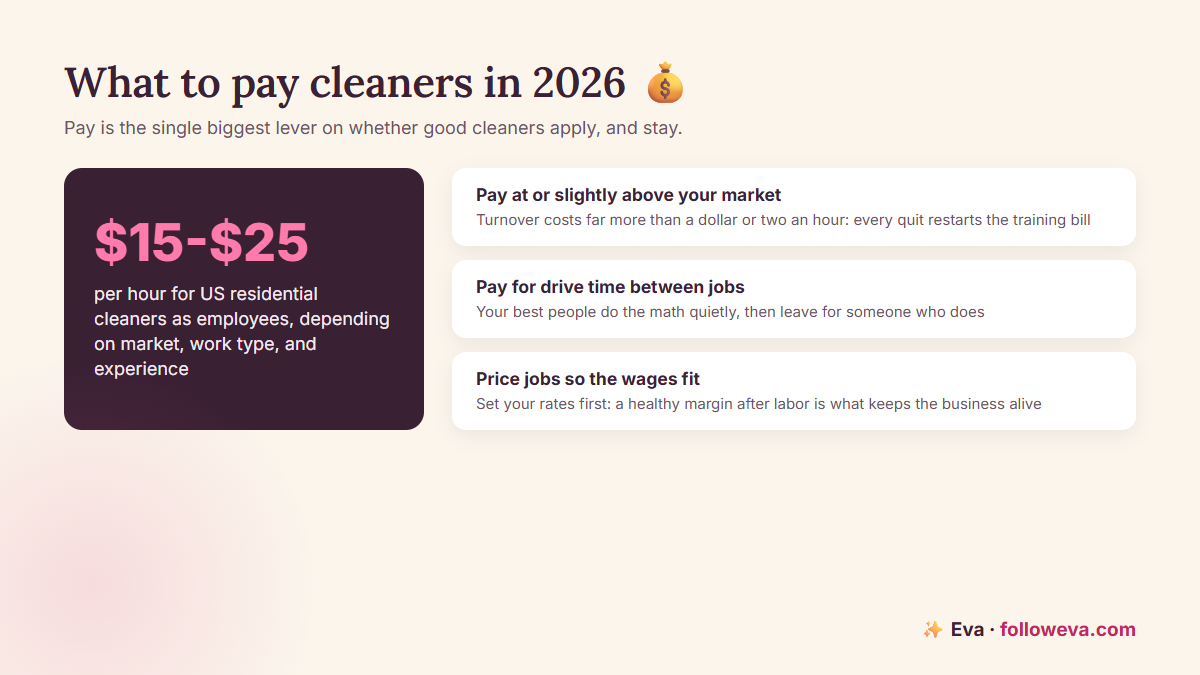
Pay is the single biggest lever on whether good cleaners apply and stay. Most US residential cleaners earn between 15 and 25 dollars an hour as employees, with the right number depending on your market, the type of work, and experience. Pay at or slightly above your local market if you want to keep people, because turnover is far more expensive than a dollar or two more an hour: every time someone quits, you lose the time and money you spent training them. Pay for drive time between jobs too, or your best people quietly do the math and leave. Before you set wages, make sure your prices leave room for them, since a healthy margin after labor is what keeps the business alive.
How to screen and interview
Reliability matters more than a polished resume in this work, so screen for it: did they show up to the interview on time, do they answer messages, can they give references from past cleaning or service jobs. The most useful step is a paid working interview, a single real clean where you watch how they work, how they treat the home, and whether they follow instructions. One paid trial clean tells you more than three conversations. Run a background check where appropriate, and trust the small signals: punctuality and care at the interview usually predict punctuality and care on the job.
Onboarding and keeping quality consistent
Hiring is step one; the real job is keeping every clean consistent as you add people. The simplest quality system is a shared checklist that sets the standard for every home, so a new cleaner knows exactly what done looks like. Build one with our free cleaning checklist generator, or start from a house cleaning checklist template. Pair it with a short ride-along on the first few jobs, clear expectations, and quick feedback. The goal is that the quality that won you the client does not slip just because you were not the one holding the mop.
Let the system do the managing
As your team grows, the hard part is no longer the cleaning, it is the coordination: who goes where, did they show up, was it done right. That is exactly what Eva handles. She builds the schedule and assigns the right cleaner to each job, sends the checklist to each cleaner's phone for every visit, and tracks clock-in and photos so you know the work was done to standard. It is the difference between hiring help and actually having a manager for your team, without the cost of one. Start free, and grow your team without growing the chaos.
Hiring cleaners: FAQ
How much should I pay my cleaners?
Enough to keep the good ones: in most US markets that means meaningfully above local minimum wage, plus paid drive time and supplies provided. Turnover is the most expensive line item in a cleaning business, and a couple of dollars an hour is cheaper than constantly rehiring and retraining.
Should cleaners be employees or independent contractors?
If you want to train them, schedule them, and hold them to your checklist, that is employee control, and classifying such workers as 1099 contractors creates real legal risk. Rules vary by state; check your state's worker-classification guidance before deciding.
How do I write a job post that attracts good cleaners?
Name the pay and schedule up front, be honest about the physical work, and describe what a great clean looks like. Specific posts screen out the wrong applicants for you. Our free cleaner job description generator builds one you can paste into Indeed or Facebook.